RCA Lyra MP3
The crappiest product ever made!
price $200-250
Available Now. ...available for the garbage!
Word and pictures: Marcus
Model: Dina Marie
 So
it would be nice to have a portable MP3 player wouldn't it? Just
think, solid state no moving parts, less power usage and less to
break when dropped. shock proof too, the music will never skip.
So that is how the dream goes. In reality there are quite a few
short comings. Especially with the first MP3 player I've reviewed
the RCA Lyra.
So
it would be nice to have a portable MP3 player wouldn't it? Just
think, solid state no moving parts, less power usage and less to
break when dropped. shock proof too, the music will never skip.
So that is how the dream goes. In reality there are quite a few
short comings. Especially with the first MP3 player I've reviewed
the RCA Lyra.
First
let me start with why I chose the Lyra as the first MP3 review.
The primary reason I chose the Lyra was its utilization of the compact
flash card as it's storage media. Compact flash cards can hold a
lot more than their main rival the smart media card. Compact flash
cards can hold 128 megs of storage ($322.00 at camera world) while
the largest smart media card can only hold 32 megs. ($119.32 at
camera world) Since I and many other people already have a collection
of CF cards for use with digital cameras, a MP3 player that uses
the same media is very useful. But wait there's more, the Lyra is
able to also use the type two CF card which can hold as much as
340 megs. ($479 at camera world.) So as you can see the advantages
of the Lyra seem quite numerous. Read on to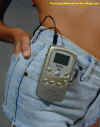 see where the real life let down happens.
Lets start with the installation of the software. The RCA Lyra comes bundled with "Real jukebox" software to convert or "rip" existing CD's into MP3 files to be transferred to the Lyra. A parallel port driver has to be installed as well in order to transfer the music into the compact flash card. After installing the two programs, I found out that my computer would not boot into Windows because of a general protection fault. Well isn't that nice. I was forced to re-install Windows. But hold on that's not all, because I am an impatient bugger, I decided to install the software on a second computer I had laying around. Guess what, that computer also had the same general protection fault and I had to re install Windows on it as well. Naturally I called Thomson electronics (the parent company of RCA). I had to spend my own long distance dollar too (no 800 number.) After being on hold for 20 minutes, Thomson told me that there was no way that there software could have possibly caused the problem and to give Real a call. I asked Thomson for Real's phone number but the number they gave me belonged to a law firm in Seattle. Please don't accuse me of being incapable of dialing a phone number because I called Thomson back to confirm the number they gave me and it was still the law firm. I say boycott all Thomson products! they don't deserve any business. Well eventually I did get the software installed and found out that the Real Jukebox software is a demo version only! It will only let you rip 60 CD's before it locks down and stops functioning. It will only let you rip at 128 k. You have to upgrade the program in order to rip at 320 k. I ask you can this be okay? I mean they sell you the product at one price and then they demand more money to continue to use it. Thanks a lot. One good thing about the real jukebox is it rip quickly. On a Pentium I I 400 it would rip at 4.5 times normal listening speed.
Once the music was ripped You then have to transfer it to the CF card. 128 Megs of MP3 music takes 30 minutes to transfer via the parallel port reader. It would be nice to be able to use your USB card reader but the Jukebox software doesn't support this.
 Okay,
finally you have the Lyra ready to go so what's the quality of the
sound like? Not so great to tell you the truth. It might be because
of the 128 K limit to recording quality but I can hear back ground
noise during quiet parts of songs. In addition to that, at the beginning
of every song there is a loud static pop sound, which was very annoying.
The unit did put out a lot of volume though. Much more than my Sony
MiniDisc player. I did not use the cheapish head phones that came
with the unit very much because they are uncomfortable and did not
sound as good as
Okay,
finally you have the Lyra ready to go so what's the quality of the
sound like? Not so great to tell you the truth. It might be because
of the 128 K limit to recording quality but I can hear back ground
noise during quiet parts of songs. In addition to that, at the beginning
of every song there is a loud static pop sound, which was very annoying.
The unit did put out a lot of volume though. Much more than my Sony
MiniDisc player. I did not use the cheapish head phones that came
with the unit very much because they are uncomfortable and did not
sound as good as the Sennheiser phones I normally use. They are much larger than
the stock head phones. However they are much more comfortable and
sound better. They don't look half bad on Dina Marie either.
the Sennheiser phones I normally use. They are much larger than
the stock head phones. However they are much more comfortable and
sound better. They don't look half bad on Dina Marie either.
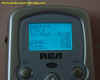 The
Lyra does have a backlite info screen which is a good thing. There,
I said something nice about it now let get busy.
The
Lyra does have a backlite info screen which is a good thing. There,
I said something nice about it now let get busy.
More bad stuff: It doesn't remember the volume level when it is shut off and it resets to a very low level when turned on again. It takes about 4 seconds to crank up the volume each and every time the unit is started. The Lyra does have a pause function to it so that you can answer the phone for a short time but if your phone call goes over 60 seconds in length then the Lyra powers down. Causing you to have to re-adjust the volume and start the song that you were listening to from the beginning. What a pain. MD players have moving parts taking up more energy and they still allow the user to but them on pause for more than two minutes. The Lyra also is missing a hold button feature, this is a necessity in my opinion. There are few things more frustrating than being near the end of a twenty minute song and have a button accidentally pressed starting the song over from the beginning. A number of the Lyra's competitors have the ability to record sound with an onboard microphone. The makers of the Lyra decided that this would not be the case in there unit.
One
more thing, the RCA Lyra is too large. It is just as large as a
MD player. Considering that the CF media is a quarter the size of
a MiniDisc one would think that the CF player should also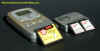 shrink in size. Look at this photo of the Lyra and its competition
the Digitra MP-Trio, look at the size difference.
shrink in size. Look at this photo of the Lyra and its competition
the Digitra MP-Trio, look at the size difference.
Hopefully this review has convinced you to stay away from the RCA Lyra. Check back soon for a review of the pre-production Digitra MP-Trio it is much better, then again any MP3 player is better than the Lyra.
M.